
Devices
CXTM Test Automation
  • Introduction
  • NaC Introduction
  • Manual Validation
  • CXTM Introduction
  • CXTM Projects
  • CXTM Test Cases
  • CXTM Test Automation
  • CXTM Git Integration
  • CXTM Batches
  • CXTM Notifications
  • Final Deployment
  • CXTM Reporting
  • CXTM References
  • Bonus Content

CXTM Devices

CXTM leverages the unicon framework of device control libraries to define how connections should be established to the devices in the testbed, such as routers, switches, and servers. The unicon framework stores the device connection parameters (protocols, IP addresses, ports, etc) and credentials in a testbed file in YAML format.

The Devices page allows CXTM users the ability to easily generate these YAML testbed topology files without having to worry about the underlying YAML file structure expected by unicon. In addition, CXTM takes care to ensure that device credentials are properly protected with encryption.

CXTM offers multiple options to create this testbed topology file. Users can use the provided CSV template to add the device inventory in bulk, create and import topology files programmatically, or add devices individually. In the following steps you will use the CXTM GUI to add a device from your CML lab. In the upcoming Topologies section of the lab, you will add the YAML file directly into CXTM from this lab guide.

Step 1 - Navigate to Project Devices

From within your project:

  1. If not already expanded, expand the left sidebar


  2. Scroll down until you locate the heading Project Automation
  3. Under Project Automation, click Devices


Step 2 - Launch New Device Pop-Up


On your project Devices page:

  1. Click New Device to add a new device.


Step 3 - Review the default Device Details pop-up

  1. Notice the "*" beside Hostname

  2. The Hostname is a mandatory field, and as noted in the pop-up, it "must be unique for this project and it must match the device prompt exactly" or the connection will fail. For that reason, be sure to copy/paste the Hostnames from this lab guide into the Device Details pop-up exactly as provided.

  3. Notice that the Connector OS defaults to Linux

  4. The Connector OS maps to the "os:" value in the YAML topology file, and identifies the proper unicon plugin to use when creating a connection to the device. This will change dynamically based on your Device OS selections in subsequent steps.


Step 4 - Add S1 Device

In the Device Details pop-up, enter the below information to add the S1 device to your lab topology.

When entering the below information, notice that after selecting "nexus" from the Device OS dropdown and "9k" from the Sub Category dropdown, that the Connector OS is automatically changed from "Linux (default)" to "NXOS".
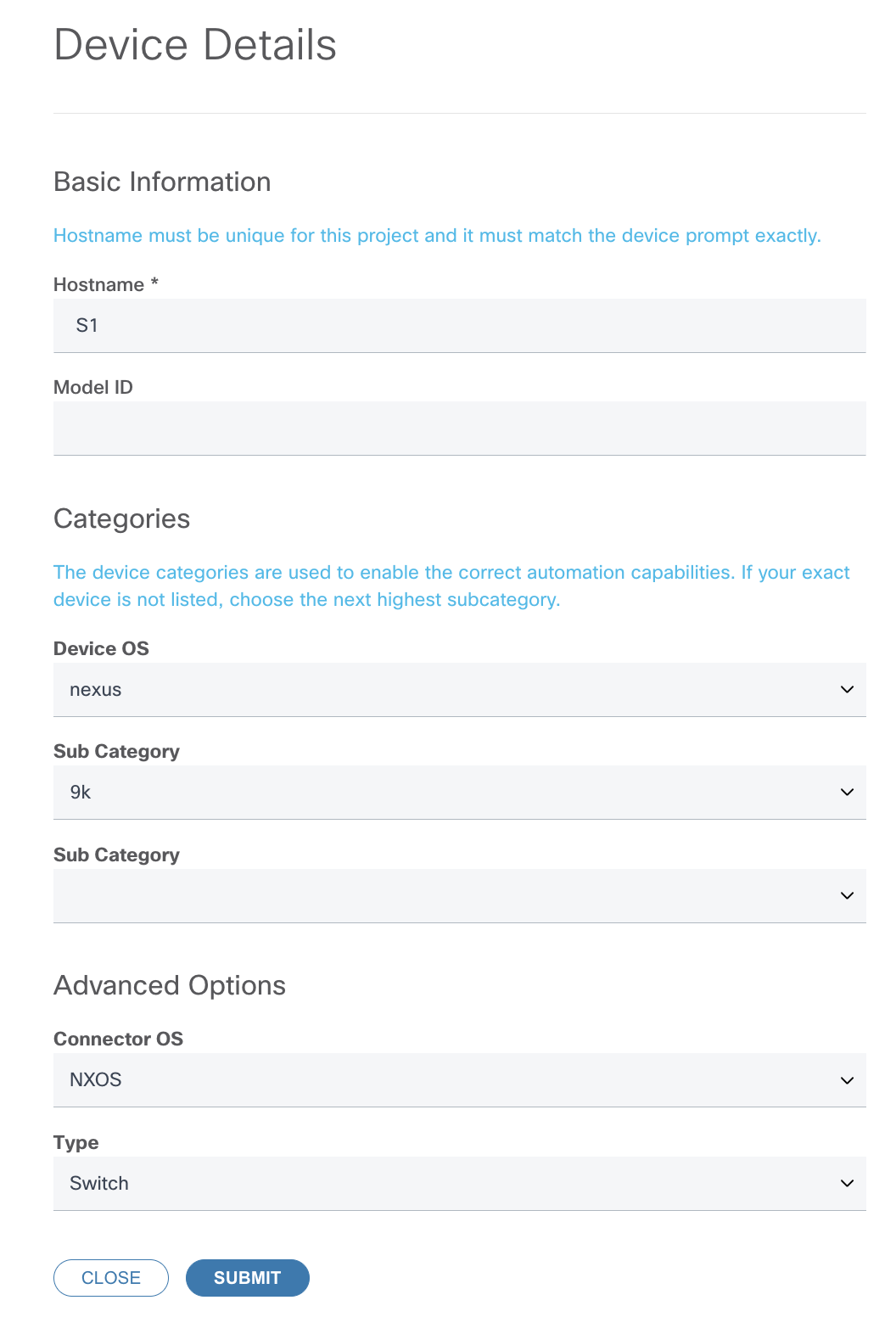
  1. Hostname: S1
  2. Device OS: Select nexus
  3. Sub Category: Select 9k
  4. Connector OS: Select NXOS
  5. Type: Select Router
  6. Click SUBMIT


Step 5 - For S1 Device Select New Connection

Add a connection to your S1 device:

  1. Click New Connection under the device hostname


Step 6 - Add S1 Device SSH Connection

In the Connection Details pop-up, enter the below information to add an ssh connection to the device:

When entering in the device credentials, notice that the passwords are not displayed in clear text in the Connection Details menu.

  1. Connection Type: Standard Connection
  2. Connection Name: ssh
  3. Username: admin
  4. Uncheck Use Secret for Password
  5. Password: cisco.123
  6. Verify Password: cisco.123
  7. Protocol: ssh
  8. IP Address: 10.15.103.21
  9. Click the checkbox for Make this the default connection
  10. Click SUBMIT


Step 7 - Review devices added to your project


On your project Devices page:

  1. Review the Devices page after adding the S1 device

  2. The Devices page should now resemble the following example.


    Notice that most of the connection parameters entered in the preceding steps (protocols, IP addresses, ports, etc) are visible on this page, but the device passwords are not displayed.


Step 8 - Preview the YAML topology file


On your project Devices page:

  1. Click Preview


  2. Review the YAML topology file displayed

  3. Take a moment to review how the data you entered on the devices page has been rendered in this output. The Robot Job Files you develop in the next sections will leverage the information collected in this file.

    Also, notice that the passwords entered in the preceding steps are encrypted in this output.
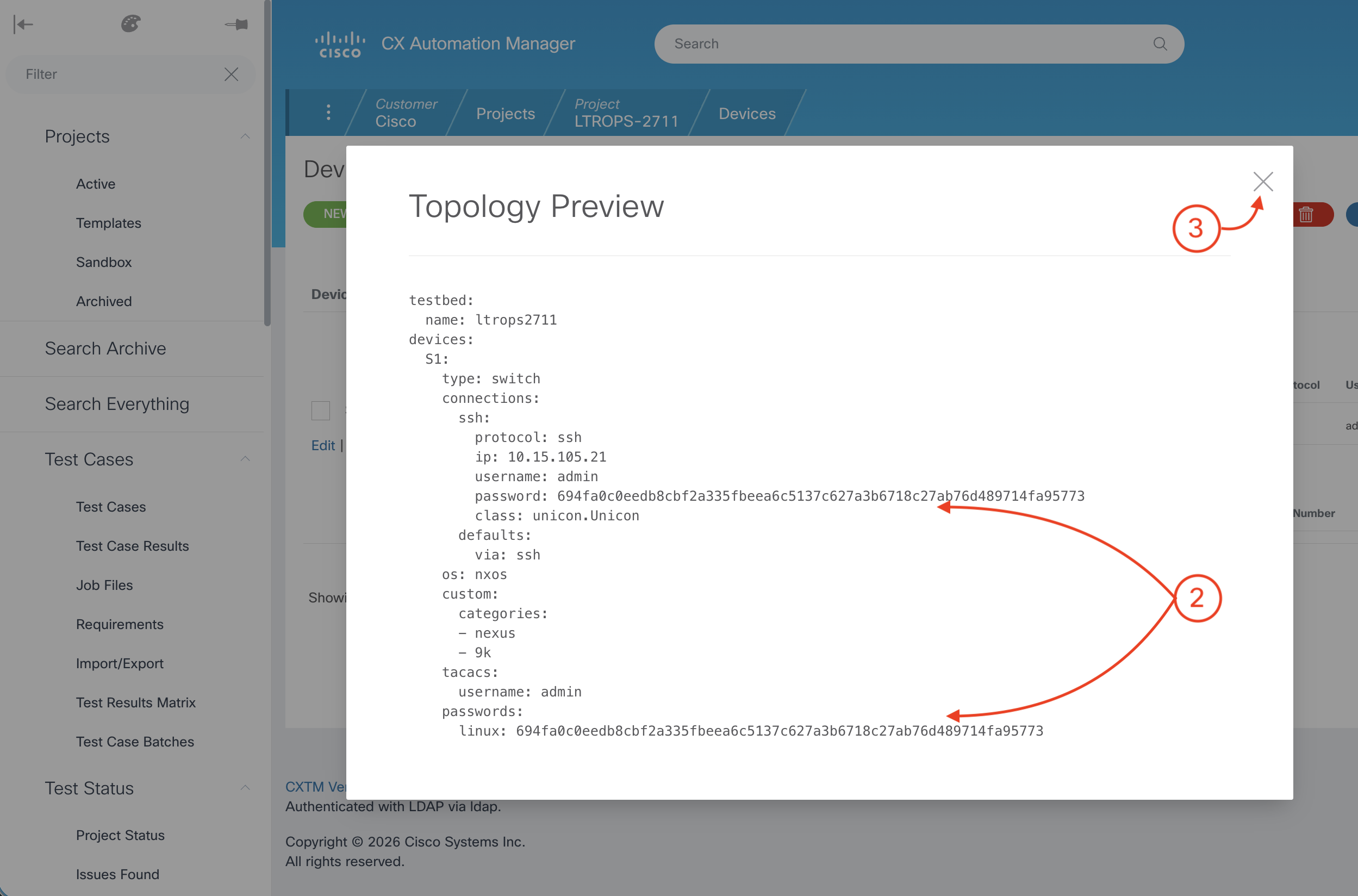
  4. Click the X button to close the preview pane


In the interest of time, the remaining devices in your testbed have already been added to a YAML topology file for you in the next section of the lab guide. Continue to the next section to learn how to create a topology through the CXTM Topologies page.